
Appreciation of Leonardo da Vinci's "Mona Lisa".
author: sun flower
2024-03-20
The Mona Lisa is an oil painting by the Italian Renaissance painter Leonardo da Vinci, now in the collection of the Louvre Museum in France. "Mona Lisa" represents the aesthetic direction of the Renaissance, and the work reflects the profound and noble ideological quality of women, reflecting the aesthetic concept and aesthetic pursuit of female beauty in the Renaissance. The Renaissance was a European intellectual and cultural movement that flourished from the 14th to the 17th centuries. It originated in Florence in the late Middle Ages and later spread to various European countries. Europe's critique of the Middle Ages under Christian domination gave rise to secular values. The idea of man is at the heart of the ideas of artists such as Leonardo da Vinci, and the Mona Lisa also shows the brilliance of divinity and humanity, affirming the meaning of man's existence separated from the state of nature.

The dimensions of the original Mona Lisa: 77 cm in height and 53 cm in width, the work is painted on a black poplar board. The Mona Lisa portrait has no eyebrows or eyelashes, and the face looks very harmonious. If you look directly at the Mona Lisa's mouth, you will feel that she is not smiling, but when you look into her eyes and feel the shadow on her cheeks, you will feel that she is smiling. Some researchers used the micro-expression theory to conclude that the smile of the Mona Lisa contains 83% happiness, 9% disgust, 6% fear, and 2% anger. She sits on a semi-circular wooden chair with a railing behind her, separating the figures from the background, with roads, rivers, bridges, and mountains, which merge with the smile of the Mona Lisa under da Vinci's "unbounded gradient coloring" brushwork, exuding a dreamy and mysterious atmosphere.
In his Mona Lisa paintings, Leonardo da Vinci successfully used the "fading method" painting technique. The "Mona Lisa" figure is not very clear with the background, and the outline of the character is not so clear, as if blending into the background. Especially at the corners of the eyes and mouth of the figure, the author deliberately uses the "fading method" painting technique, so that the corners of the eyes and mouth gradually melt into the soft shadows, thus creating a subtle artistic effect and greatly enriching the meaning of the image.
This painting represents the meaning of Leonardo da Vinci's gaze on the world through the eyes of Christ, but this is not to say that the high level of art is an abstract spirit that is confusing. On the contrary, this state is a concrete abstraction that is revealed through concrete images. The eyes, forehead, mouth, and unique hands of the "Mona Lisa" are all vivid and concrete, rather than a reproduction of simple concepts, so it is necessary for art to sublimate the human spirit into a visual image, and it is possible and inevitable to purify the visible image into a religious realm, and beauty and mystery have an indissoluble cause.
How many stages have Impressionism gone through so far?
Types and characteristics of canvases for oil paintings?
Related Article

"Baroque" is an art style that flourished in Europe between 1600 and 1750. It arose in Italy during the Counter-Reformation, developed in most parts of Europe where Catholicism was practiced, and later spread to Latin American and Asian countries as Catholicism spread. As an art style that had a profound influence on time and space, the rise of Baroque was closely related to the religion of the time.
Do you know what great changes have taken place in Baroque art since the Renaissance?
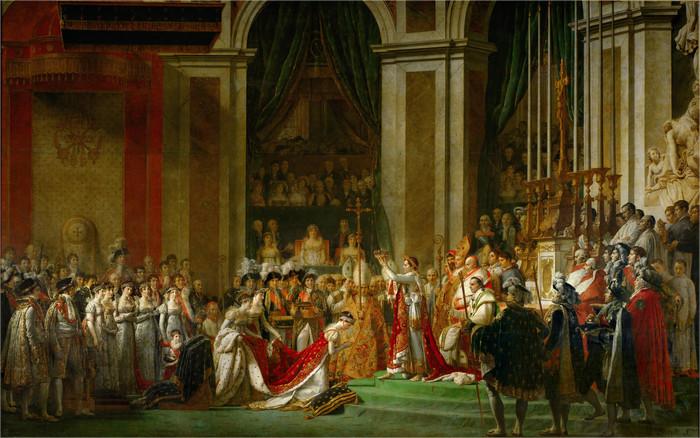
Classicism is the expression of the classicism popular in Europe in the 18th century, and they were dissatisfied with the extravagant Rococo art that served the aristocracy, and sought new themes from classical Greek and Roman art.
The development of the Classicist school
Realism, as an artistic movement, emerged at the same time as the French Revolution of 1848. The painter Courbet and the theorist Jean Fleury were its spiritual leaders.
Post-Renaissance realism
The Romantic school of painting took affirmation and praise of people's spiritual values and the struggle for individual emancipation and human rights as its ideological principles. In painting, he advocates the depiction of personality and characteristics and the expression of emotions.
Post-Renaissance Romanticism